

The User-Centred
Law Firm Website DesignYour Website Isn’t Built for You. It’s Built for Your Clients.
Why audience insight and user experience are reshaping modern law firm website strategy.
Most law firm websites are organised around the firm’s structure.
Practice areas. Sectors. Departments. Internal hierarchies.
It makes perfect sense to the people inside the business.
The problem is that clients don’t think that way.
When someone arrives on your website, they’re rarely looking for a practice area. They’re looking for a solution. They have a challenge, an opportunity, a risk, a transaction, a dispute or a decision to make. They want reassurance that they’re in the right place and confidence that you understand what they’re trying to achieve.
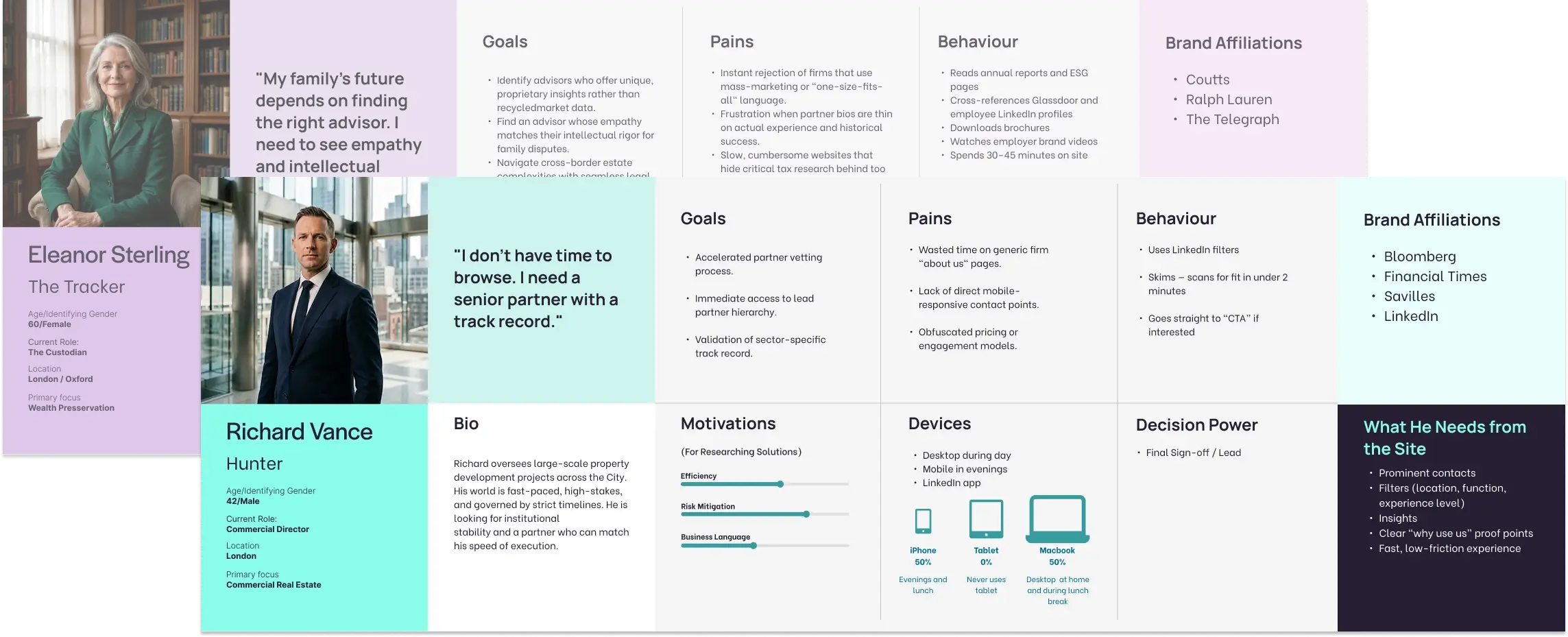
This is why persona research remains one of the most valuable exercises in modern law firm website strategy.
Stop Thinking About Services. Start Thinking About People.
The most effective websites are designed around the needs of the people using them.
For a law firm, those audiences can be remarkably diverse:
- A General Counsel looking for specialist expertise.
- A property developer navigating a complex planning issue.
- A school leader seeking regulatory advice.
- A private client managing a family matter.
- A CEO facing a reputational challenge.
Each audience arrives with different motivations, concerns and expectations.
Yet many websites present the same information in the same way to everyone.
The result is often a law firm digital experience that feels generic, difficult to navigate and disconnected from the client’s actual needs.
These changing user expectations are also reflected in our latest UK Legal Sector Digital Market Share Report 2025.

Understanding What Drives Action
Persona development isn’t about creating fictional characters.
It’s about understanding what drives decision-making.
What questions are clients asking?
What information do they need before they contact a firm?
What concerns are preventing them from taking the next step?
What evidence builds trust?
What signals demonstrate expertise?
When you understand these factors, you can begin designing journeys that help users move forward with confidence.
The website becomes less of a brochure and more of a guide.
Better Insights Create Better Digital Experiences
The real value of persona research extends far beyond content.
It informs:
- Information architecture.
- Navigation structures.
- Messaging and positioning.
- User journeys.
- Calls to action.
- Creative direction.
- Conversion strategy.
Every decision becomes grounded in audience insight rather than assumption.
Instead of organising information according to how the firm operates internally, the experience is shaped around how clients actually think and behave.
The Firms That Win Are the Ones That Feel Relevant
Legal expertise is rarely the deciding factor.
Most prospective clients assume that leading firms are technically competent.
What differentiates one firm from another is often relevance.
Does the firm understand my situation?
Do they speak my language?
Can I quickly find what I need?
Do I feel confident placing my trust in them?
The firms that answer those questions most effectively are often the firms that generate more enquiries, stronger engagement and better-quality leads.
Designing Around Human Behaviour
At Konstructive, we believe the best digital experiences start with understanding people.
Before we think about navigation, content or design, we focus on the audiences a firm wants to reach and the outcomes those audiences are trying to achieve.
Because a successful legal website isn’t simply one that looks good.
It’s one that helps the right people find the right information, build trust and take action.
And that starts with understanding who they are in the first place.